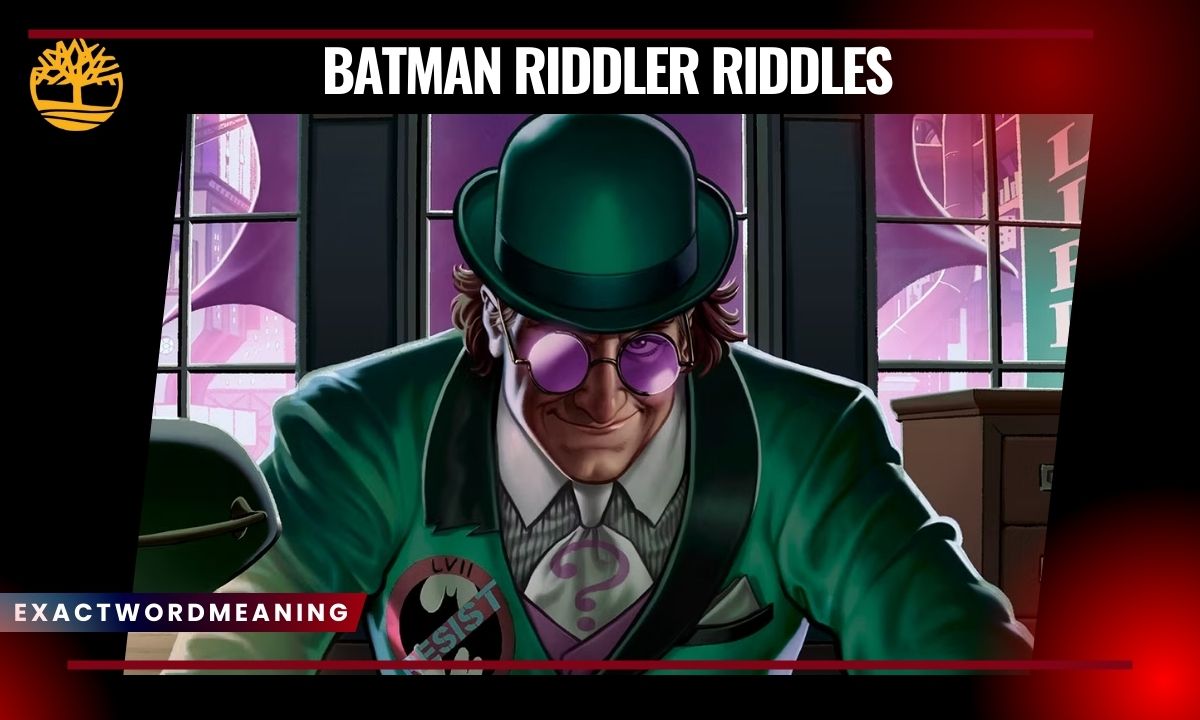
The Riddler’s riddles are more than clever questions. They are traps built from words, logic, and ego. Each one forces Batman, and the audience, to slow down and think deeper.
From playful word tricks to dark moral tests, these puzzles shape entire Batman stories. Solving them often reveals corruption, hidden truths, or the Riddler’s fractured mind.
This guide explores the most memorable Riddler riddles with answers, showing how Edward Nygma uses intelligence as both a weapon and a confession.
Who Is The Riddler? Batman’s Master of Mind Games
Edward Nygma is driven by one obsession: proving he is the smartest person in the room. His need for validation began in childhood and grew into a lifelong rivalry with Batman. Unlike other villains, the Riddler doesn’t rely on strength or fear alone. He uses riddles, codes, and puzzles to control the game and force Batman to play by his rules.
Batman is the only opponent he truly respects. Every riddle is a challenge, a message, and a demand to be understood. The Riddler doesn’t just want to win. He wants his intelligence recognized, even if the cost is chaos, danger, or lives.
Classic Batman Riddler Riddles From Comics
The Riddler’s earliest riddles appeared in the comics starting with Detective Comics #140 (1948). Edward Nygma’s puzzles weren’t just clever wordplay; they were a psychological weapon designed to challenge Batman’s mind while entertaining readers. These riddles span decades, from simple puns to intricate puzzles hidden in Gotham’s narrative. They show the evolution of the character and how riddles became central to his identity.
- The Riddle: Why is corn hard to escape from?
The Answer: Because it’s a maize.
The explanation: Edward Nygma’s very first riddle, a pun combining corn (maize) with a maze, establishes his playful yet cunning style. It sets the tone for the character’s obsession with wordplay. - The Riddle: How can one get into a locked cemetery at night?
The Answer: With a skeleton key.
The explanation: This riddle uses literal and figurative meaning, combining a physical key with the skeleton imagery common in macabre settings. - The Riddle: I can be cracked. I can be made. I can be told. I can be played.
The Answer: A joke.
The explanation: Here, the Riddler blurs the line between humor and intellect, showing that his mind works on multiple levels simultaneously. - The Riddle: What is always on its way here but never arrives?
The Answer: Tomorrow.
The explanation: A philosophical question from the 1960s show, testing Batman’s ability to think abstractly beyond immediate logic. - The Riddle: Without fingers I point, without arms I strike, without feet I run.
The Answer: A clock.
The explanation: This riddle personifies time, forcing the solver to look beyond the human literal form and recognize attributes in objects. - The Riddle: What does a liar do when he’s dead?
The Answer: He lies still.
The explanation: A dark twist used later in films, punning on “lies” as both physical and verbal. - The Riddle: If you throw me out of the window, I’ll leave a grieving wife. Bring me back, but through a door, you’ll see someone giving life.
The Answer: The letter N.
The explanation: This cryptic puzzle highlights the Riddler’s love for wordplay and coded messages. - The Riddle: What President of the United States wore the biggest hat?
The Answer: The one with the biggest head.
The explanation: Classic 1960s humor; simple, yet clever wordplay that plays on expectations. - The Riddle: I have billions of eyes, yet I live in darkness. I have millions of ears, yet only four lobes. I have no muscle, yet rule two hemispheres.
The Answer: The human brain.
The explanation: This riddle from Batman: The Animated Series emphasizes intellect over brute strength and reveals the Riddler’s fascination with the human mind. - The Riddle: You pass the runner in second place during a race. What place are you in now?
The Answer: Second place.
The explanation: A logical riddle that relies on careful reading and understanding the phrasing, demonstrating Batman’s need for precision. - The Riddle: Two fathers and two sons went fishing. Each caught one fish, but only three fish were caught total. How?
The Answer: Grandfather, father, and son.
The explanation: The Riddler frequently uses familial and numerical tricks to misdirect, teaching readers to question assumptions. - The Riddle: What has a head and a tail but no body?
The Answer: A coin.
The explanation: Simple but effective, testing lateral thinking and common word associations. - The Riddle: What belongs to you, but is used more by others?
The Answer: Your name.
The explanation: A clever twist on ownership, highlighting how perception and communication play into his puzzles. - The Riddle: What has roots that nobody sees, is taller than trees, up it goes, and yet never grows?
The Answer: A mountain.
The explanation: A riddle combining natural imagery with abstraction, forcing solvers to think beyond literal growth. - The Riddle: What is the beginning of eternity, the end of time and space, the beginning of every end, and the end of every race?
The Answer: The letter “E”.
The explanation: A letter-based puzzle illustrating how the Riddler toys with language itself. - The Riddle: What has keys but can’t open locks?
The Answer: A piano.
The explanation: Musical wordplay disguised as a logic puzzle, combining literal and figurative thinking. - The Riddle: What can travel around the world while staying in a corner?
The Answer: A stamp.
The explanation: Another lateral thinking riddle, showing the Riddler’s skill in misdirection. - The Riddle: Which triangle has a bigger area: one with sides 300, 400, and 500, or one with sides 300, 400, and 700?
The Answer: The 300-400-500 triangle.
The explanation: A math-based riddle emphasizing logical rules and problem-solving, often ignored in favor of simpler tricks. - The Riddle: What comes once in a minute, twice in a moment, but never in a thousand years?
The Answer: The letter “M”.
The explanation: This classic wordplay puzzle showcases the Riddler’s ability to manipulate language and timing. - The Riddle: What has four wheels and flies?
The Answer: A garbage truck.
The explanation: A humorous riddle that demonstrates how the Riddler balances menace with wit.
Funny Riddler Riddles That Use Clever Wordplay
The Riddler has always had a lighter side, especially in the 1960s and Jim Carrey’s Batman Forever. His funny riddles rely on puns, literal thinking, and playful twists to entertain as much as to challenge. They often test Batman’s patience while providing the audience with a mix of amusement and intellectual satisfaction.
- The Riddle: Which President wore the biggest hat?
The Answer: The one with the biggest head.
The explanation: Simple, pun-based humor highlighting the Riddler’s playful side. - The Riddle: How does an exhibitionist garbage collector break up with his girlfriend?
The Answer: He dumps her in public.
The explanation: Wordplay that uses double meanings, testing attention to language. - The Riddle: If you look at the numbers on my face, you won’t find 13 anyplace.
The Answer: A clock.
The explanation: Classic visual and logical pun blending real-world observation with clever misdirection. - The Riddle: What is always on its way here but never arrives?
The Answer: Tomorrow.
The explanation: Light existential humor that makes the audience think while smiling. - The Riddle: What has keys but can’t open locks?
The Answer: A piano.
The explanation: Fun wordplay demonstrating the Riddler’s love of musical puns. - The Riddle: What has a head and a tail but no body?
The Answer: A coin.
The explanation: A simple joke that requires lateral thinking. - The Riddle: There were three men in a boat with four cigarettes and no matches. How did they manage to smoke?
The Answer: They threw one cigarette overboard to make the boat a cigarette lighter.
The explanation: Classic pun, showing the Riddler’s comedic ingenuity. - The Riddle: When is the time of a clock like the whistle of a train?
The Answer: Two to two. Too too too!
The explanation: Wordplay humor that mixes language and observation. - The Riddle: What is it that no man wants to have yet no man wants to lose?
The Answer: A lawsuit.
The explanation: Legal pun turned riddle, blending real-world wit and intellect. - The Riddle: Why is corn hard to escape from?
The Answer: Because it’s a maize.
The explanation: The first-ever Riddler riddle, humorous and clever in its pun. - The Riddle: You are El Rata Alada.
The Answer: www.rataalada.com
The explanation: Wordplay in the form of a homophone, combining riddles with digital media. - The Riddle: If you throw me out of the window, I’ll leave a grieving wife. Bring me back through a door, you’ll see someone giving life.
The Answer: The letter N.
The explanation: Clever manipulation of letters with hidden meanings. - The Riddle: What belongs to you, but others use it more than you?
The Answer: Your name.
The explanation: A humorous, yet thought-provoking twist. - The Riddle: The less of them you have, the more one is worth.
The Answer: A friend.
The explanation: Light-hearted and meaningful, demonstrating Riddler’s emotional side. - The Riddle: I can be cracked, made, told, or played.
The Answer: A joke.
The explanation: Meta-humor referencing both the Riddler’s style and the Joker. - The Riddle: Which triangle has a bigger area: 300, 400, 500 or 300, 400, 700?
The Answer: The 300-400-500 triangle.
The explanation: Math joke disguised as a serious puzzle. - The Riddle: What has roots nobody sees, is taller than trees, yet never grows?
The Answer: A mountain.
The explanation: Subtle humor combining natural imagery and lateral thinking. - The Riddle: What comes once in a minute, twice in a moment, never in a thousand years?
The Answer: The letter “M”.
The explanation: Clever wordplay that requires observation and lateral thought. - The Riddle: What can travel around the world while staying in a corner?
The Answer: A stamp.
The explanation: Pun on literal and figurative meanings, classic Riddler humor. - The Riddle: What has four wheels and flies?
The Answer: A garbage truck.
The explanation: Simple yet brilliant comedic twist that reflects the Riddler’s playful side.
Dark and Deadly Riddler Riddles From The Batman (2022)
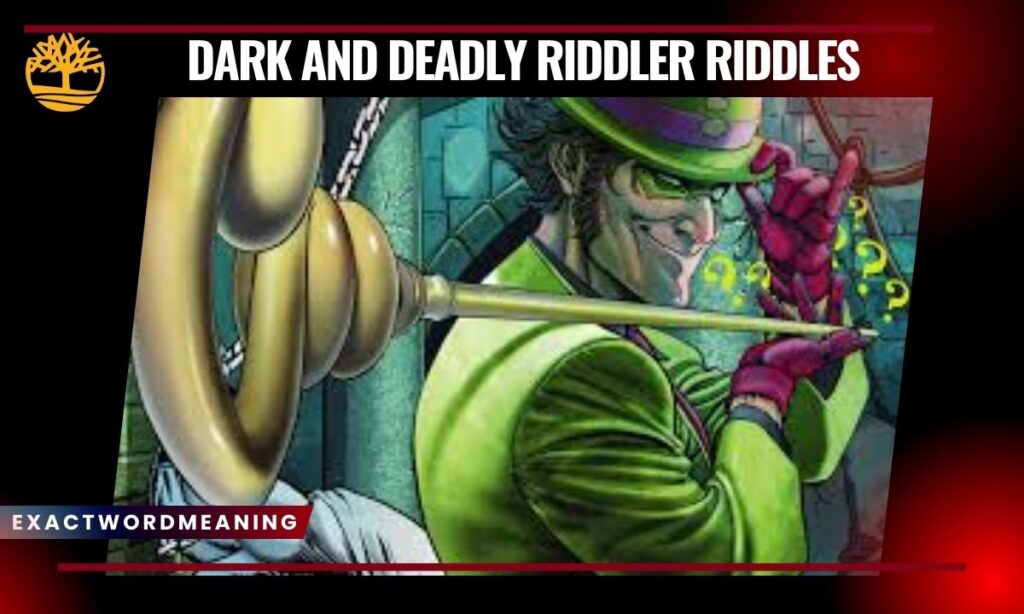
Paul Dano’s Riddler in The Batman (2022) is a far cry from campy 1960s antics. His riddles are menacing, cryptic, and often deadly, designed not just to challenge Batman but to expose corruption in Gotham. Each riddle has a dual purpose: it’s both a puzzle and a threat, revealing the Riddler’s twisted intellect and obsessive need for justice.
- The Riddle: What does a liar do when he’s dead?
The Answer: He lies still.
The explanation: A play on “lies” with both physical and moral meaning. The dead lie motionless, but his deceit continues symbolically until discovered. A chilling introduction to the Riddler’s dark humor. - The Riddle: If you are justice, please do not lie. What is the price for your blind eye?
The Answer: Bribe.
The explanation: The Riddler exposes Gotham’s corrupted officials, showing that justice can be bought. It forces Batman to confront systemic rot while solving a word-based puzzle. - The Riddle: You are el rata alada.
The Answer: www.rataalada.com
The explanation: A cryptographic homophone puzzle turning “You are el” into a URL. Batman uses it to track the Riddler’s messages, showing how modern technology amplifies his menace. - The Riddle: Follow the maze until you find the rat. Bring him into the light, and you will find where I am at.
The Answer: The Riddler’s location revealed after Batman discovers the police informant.
The explanation: This riddle tests Batman’s detective skills and moral judgment, blending literal instructions with hidden threats. - The Riddle: See you in hell.
The Answer: Arkham Asylum.
The explanation: What seems like a threat is actually a directional clue. Riddler equates the asylum with hell, showing his tendency to dramatize moral corruption. - The Riddle: I can be cracked, I can be made, I can be told, I can be played.
The Answer: A joke.
The explanation: Though dark, the Riddler still enjoys mocking his rivals (like the Joker), highlighting his superior intellect and twisted amusement. - The Riddle: Which vermin you’re paid to protect?
The Answer: The rat (police informant).
The explanation: A moral puzzle challenging Batman to confront hidden corruption. The Riddler forces recognition of complicity. - The Riddle: You won’t find 13 anyplace if you look at the numbers on my face.
The Answer: A clock.
The explanation: This simple puzzle masks deeper symbolism: the Riddler’s obsession with time, control, and mortality. - The Riddle: The less of them you have, the more one is worth.
The Answer: A friend.
The explanation: Even in darkness, the Riddler hints at connection, suggesting subtle humanity behind the mask. - The Riddle: I can bring tears to your eyes and resurrect the dead. I form in an instant and last a lifetime.
The Answer: Memory.
The explanation: A haunting reflection of Riddler’s view of consequences; memories shape Gotham’s moral landscape. - The Riddle: You’ll soon hit your mark.
The Answer: The Bat-Signal.
The explanation: A nod to iconic Batman mythology, this riddle blends literal clueing with narrative suspense. - The Riddle: What has four legs in the morning, two in the afternoon, and three in the evening?
The Answer: Man.
The explanation: A classic riddle adapted to a dark context, highlighting human vulnerability and the inevitability of mortality. - The Riddle: When is a rumor suddenly a fact?
The Answer: When the question is properly asked.
The explanation: The Riddler plays with perspective and investigative skill, emphasizing the importance of framing in truth-finding. - The Riddle: What is always moving yet stays in one place?
The Answer: A shadow.
The explanation: A metaphor for Riddler’s constant presence in Gotham, unseen but influential. - The Riddle: If you throw me out of the window, I’ll leave a grieving wife. Bring me back, and through a door you’ll see life.
The Answer: The letter N.
The explanation: Classic linguistic misdirection combined with dark narrative implications. - The Riddle: I can start a war or end one. I can give strength of heroes or leave you powerless.
The Answer: Love.
The explanation: Surprisingly emotional in a dark world, showing the Riddler’s nuanced understanding of human motivation. - The Riddle: Which triangle has a bigger area: one with sides 300, 400, 500, or 300, 400, 700?
The Answer: 300-400-500 triangle.
The explanation: A math puzzle illustrating logical precision amid chaos, reflecting Gotham’s fractured society. - The Riddle: I can make you move without touching you, yet I’m invisible.
The Answer: Wind.
The explanation: A poetic and eerie puzzle showing Riddler’s flair for observation and subtle threats. - The Riddle: What can you catch but not throw?
The Answer: A cold.
The explanation: A seemingly mundane riddle turned ominous in Gotham’s dark setting, blending humor with reality. - The Riddle: Which vermin lurks in every city, yet walks unseen?
The Answer: Corruption.
The explanation: A thematic riddle symbolizing Gotham’s decay; Riddler uses puzzles to reveal societal truths.
Psychological Riddler Riddles That Reveal His Mind
The Riddler is not just a puzzle master; he’s a window into obsession, intellect, and psychological trauma. His riddles often reflect his need for recognition, superiority, and moral judgment. By analyzing these, we understand why he obsesses over Batman, Gotham’s flaws, and his own personal identity.
- The Riddle: I can tear you apart yet make you whole. What am I?
The Answer: Truth.
The explanation: Reveals Riddler’s belief that understanding the truth is painful but necessary, reflecting his obsessive morality. - The Riddle: What do you see when you look at me?
The Answer: Yourself.
The explanation: A psychological mirror, forcing introspection, showing his fascination with human nature. - The Riddle: I am always hungry, I must always be fed.
The Answer: Fire.
The explanation: Symbolizes destructive obsession, mirroring his own compulsive behavior. - The Riddle: What is dead yet talks endlessly?
The Answer: Secrets.
The explanation: Reflects Riddler’s obsession with hidden truths and moral judgment. - The Riddle: I have cities but no houses, forests without trees, and rivers without water.
The Answer: A map.
The explanation: Cognitive riddle emphasizing abstract thinking and symbolic representation. - The Riddle: I speak without a mouth and hear without ears.
The Answer: An echo.
The explanation: Shows Riddler’s fascination with perception and communication as reflection of reality. - The Riddle: What has a beginning but no end, an end but no beginning?
The Answer: A circle.
The explanation: Symbolizes Riddler’s fixation on cycles, patterns, and his inability to escape obsession. - The Riddle: I can blind yet show clarity, destroy yet build.
The Answer: Knowledge.
The explanation: Reveals Riddler’s belief that intellect is a double-edged sword. - The Riddle: What is your greatest fear but your greatest tool?
The Answer: Your mind.
The explanation: Highlights Riddler’s philosophy that intelligence is both weapon and vulnerability. - The Riddle: I am always moving but never change.
The Answer: Time.
The explanation: Reflects his obsession with control and inevitability. - The Riddle: What defines a man, yet is invisible?
The Answer: Morality.
The explanation: Examines ethical complexity and Riddler’s judgmental nature. - The Riddle: I am caught yet never trapped, seen yet invisible.
The Answer: Thought.
The explanation: Shows Riddler’s philosophical tendencies, emphasizing mental over physical power. - The Riddle: What is dead that can speak, what is living that cannot?
The Answer: Memory.
The explanation: Connects cognition with morality, a recurring psychological theme. - The Riddle: The more you take, the more you leave behind.
The Answer: Footsteps.
The explanation: Symbolizes consequences of actions and human behavior, a recurring motif in Riddler’s psyche. - The Riddle: I can make you laugh, cry, or scream.
The Answer: Emotion.
The explanation: Illustrates his understanding of human psychology and manipulation. - The Riddle: What runs but never walks?
The Answer: Water.
The explanation: Reflects his appreciation for the invisible forces that shape life and society. - The Riddle: I am always present, yet never noticed.
The Answer: Air.
The explanation: A metaphor for subtle control and influence, echoing his approach to Gotham. - The Riddle: What has one voice but speaks to all?
The Answer: The law.
The explanation: Demonstrates his moral obsession, justice, and corruption critique. - The Riddle: What can bind yet set free?
The Answer: Rules.
The explanation: Highlights psychological and societal tension, a recurring theme in Riddler’s thinking. - The Riddle: What is invisible yet felt by all?
The Answer: Fear.
The explanation: Reveals his understanding that terror is a universal tool of control and awareness.
Romantic and Emotional Riddler Riddles Explained
While the Riddler is usually associated with puzzles and crime, certain adaptations, especially in Gotham, show a more emotional, introspective side. These riddles reveal his inner desires, vulnerabilities, and unrequited love, making him a far more complex character. Romantic and emotional riddles often use metaphor and wordplay to convey feelings, showing that Edward Nygma is more than just a villain—he is a man consumed by longing and emotion.
- The Riddle: I can start a war or end one. I can give you the strength of heroes or leave you powerless. I might be snared with a glance, but no force can compel me to stay. What am I?
The Answer: Love
The explanation: This riddle demonstrates the Riddler’s softer side, reflecting his unrequited love for Kristen Kringle in Gotham. Love is powerful, unpredictable, and uncontrollable—mirroring his inner conflict. - The Riddle: I am always with you, yet never truly held. I can lift your spirits or break your heart.
The Answer: Emotion
The explanation: Riddler acknowledges the intangible nature of feelings. His puzzles here show his struggle to understand and control human connections. - The Riddle: I am the spark that makes the night feel warm, yet I vanish when chased.
The Answer: Hope
The explanation: Love and hope intertwine. This riddle highlights his yearning for human connection despite the darkness surrounding him. - The Riddle: I am given freely but can be betrayed. I grow with attention and die in neglect.
The Answer: Trust
The explanation: Reflects Riddler’s complex relationship with allies and foes alike, emphasizing the fragility of emotional bonds. - The Riddle: I can make you weep or laugh, yet I have no face.
The Answer: Memory
The explanation: Memories of lost love or moments past can evoke strong emotion, a recurring theme in Riddler’s internal world. - The Riddle: What is the gift that cannot be bought but can be lost in an instant?
The Answer: Affection
The explanation: He recognizes the delicate balance of human relationships and how quickly they can change, reflecting his obsessive personality. - The Riddle: I am shared between two yet belong to no one. I can bind or sever hearts.
The Answer: A secret
The explanation: Emotional vulnerability is central here; the Riddler uses this to explore trust and intimacy. - The Riddle: I rise and fall like the tide, felt but unseen.
The Answer: Passion
The explanation: His riddles show a poetic side, portraying feelings as natural, unstoppable forces. - The Riddle: I can heal wounds yet leave scars, I am fleeting yet eternal.
The Answer: Love
The explanation: Even a villain can understand that love shapes us, leaving emotional marks that persist. - The Riddle: I whisper in silence and shout in absence.
The Answer: Longing
The explanation: Reveals the deep yearning in Riddler’s psyche, particularly in adaptations emphasizing his loneliness and desire. - The Riddle: What grows stronger the more it is hidden?
The Answer: Desire
The explanation: Reflects unspoken love and obsession, tying his romantic riddles to his personality traits. - The Riddle: I am fragile yet treasured, invisible yet felt by all.
The Answer: Heart
The explanation: The Riddler uses metaphor to highlight vulnerability and emotional stakes in his interactions. - The Riddle: I can bind you to someone or set you free, I exist in a glance and linger in memory.
The Answer: Connection
The explanation: This emphasizes emotional bonds and the impact of relationships on human behavior. - The Riddle: I vanish when spoken yet remain in thought.
The Answer: A secret love
The explanation: Shows Riddler’s poetic and often tragic view of romantic feelings, hinting at unrequited desires. - The Riddle: I am both your joy and your torment.
The Answer: Infatuation
The explanation: Romantic riddles reveal his fascination with the fine line between pleasure and suffering in relationships. - The Riddle: I can change your world with a glance yet disappear if ignored.
The Answer: Attraction
The explanation: His clever wordplay captures the unpredictability of emotion and human response. - The Riddle: I am sought by many, yet only a few truly find me.
The Answer: True love
The explanation: Reflects his longing for connection and the elusive nature of emotional fulfillment. - The Riddle: I am silent but speak volumes when broken.
The Answer: Heartbreak
The explanation: Emotional riddles reveal his sensitivity and ability to understand pain, even as he inflicts it on others. - The Riddle: I can lift you higher than wings but weigh heavier than stone.
The Answer: Passion
The explanation: Illustrates intensity and risk in emotional experiences, highlighting his dual fascination and fear of feelings. - The Riddle: I am never owned but often sought; I am fleeting yet eternal.
The Answer: Happiness
The explanation: Even in darkness, the Riddler’s romantic riddles show a yearning for human connection and the pursuit of joy.
Batman Riddler Riddles Based on Justice and Corruption
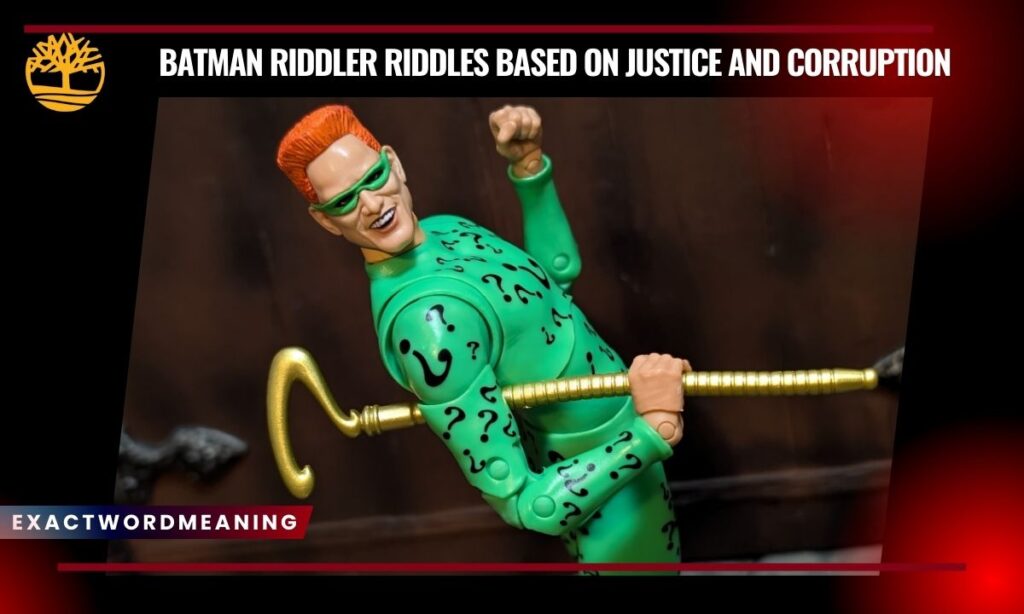
One of the core themes of the Riddler is morality. He is obsessed with justice, truth, and exposing corruption in Gotham. These riddles are not just intellectual games—they are moral challenges that force Batman and the audience to confront ethical dilemmas. The Riddler’s puzzles often highlight the hypocrisy and decay of institutions while showcasing his sharp analytical mind.
- The Riddle: If you are justice, please do not lie. What is the price for your blind eye?
The Answer: Bribe
The explanation: Highlights Gotham’s corrupted system, showing that justice can be bought. A literal puzzle and moral critique simultaneously. - The Riddle: Which vermin are you paid to protect?
The Answer: The rat (police informant)
The explanation: Points to hidden corruption and Batman’s role in exposing it. - The Riddle: Follow the maze until you find the rat. Bring him into the light, and you’ll find where I am.
The Answer: The Riddler’s location revealed after discovering the informant.
The explanation: A puzzle and ethical challenge, forcing Batman to act within moral and investigative limits. - The Riddle: I can blind yet show clarity, destroy yet build.
The Answer: Knowledge
The explanation: Reflects that awareness of corruption is both empowering and burdensome. - The Riddle: What defines right but is invisible to those who do wrong?
The Answer: Integrity
The explanation: Moral reasoning underpins Riddler’s psychological tactics, forcing introspection. - The Riddle: I am everywhere yet unseen, controlling decisions silently.
The Answer: Influence
The explanation: Highlights subtle manipulation in Gotham’s elite and systemic corruption. - The Riddle: What is always judged yet often ignored?
The Answer: Justice
The explanation: Demonstrates Riddler’s critique of selective law enforcement and societal hypocrisy. - The Riddle: I can punish the guilty yet empower the innocent.
The Answer: Truth
The explanation: A philosophical riddle emphasizing that exposing corruption restores balance. - The Riddle: I am sought by many, yet only a few dare wield me.
The Answer: Power
The explanation: Riddler critiques those who exploit authority rather than uphold justice. - The Riddle: What can hold someone accountable yet escape accountability itself?
The Answer: The law
The explanation: Shows Gotham’s flawed justice system and the moral complexity of crime and punishment. - The Riddle: I reveal the guilty yet hide the innocent.
The Answer: Evidence
The explanation: This riddle combines moral and detective themes, forcing Batman to analyze carefully. - The Riddle: I can expose lies yet be twisted into deceit.
The Answer: Truth
The explanation: Highlights Riddler’s understanding that morality is often subjective in Gotham’s corrupt world. - The Riddle: What is owed to the innocent but stolen by the powerful?
The Answer: Justice
The explanation: A recurring theme in the 2022 movie and comics, showcasing his crusade against inequality. - The Riddle: I judge actions yet never act myself.
The Answer: Conscience
The explanation: Reflects Riddler’s psychological projection, turning morality into a puzzle. - The Riddle: I can reward the brave yet punish the cowardly.
The Answer: Fate
The explanation: Philosophical in nature, showing how the Riddler intertwines morality with consequence. - The Riddle: What is invisible yet shapes every decision?
The Answer: Corruption
The explanation: Highlights societal decay and the hidden influence on both heroes and villains. - The Riddle: I can free the oppressed yet enslave the powerful.
The Answer: Exposure
The explanation: Riddler’s riddles emphasize revelation and accountability, linking intelligence to justice. - The Riddle: I am often ignored yet feared by the guilty.
The Answer: The truth
The explanation: Exposing lies is central to his moral puzzles. - The Riddle: I can destroy empires with a single word.
The Answer: Evidence
The explanation: Represents the fragile balance between morality, law, and intelligence in Gotham. - The Riddle: I am the light in darkness yet invisible to the blinded.
The Answer: Justice
The explanation: Reinforces his obsession with righting wrongs and punishing corruption, showing that morality is both guiding and elusive.
Smart Letter and Wordplay Riddler Riddles
| The Riddle | The Answer |
| Why is corn hard to escape from? | A maize |
| If you throw me out of the window, I’ll leave a grieving wife. Bring me back, but through a door, You’ll see someone giving life. | The letter N |
| I can be cracked. I can be made. I can be told. I can be played. | A joke |
| When is the time of a clock like the whistle of a train? | Two to two (Too too too) |
| What comes once in a minute, twice in a moment, but never in a thousand years? | The letter M |
| What is the beginning of eternity, the end of time and space, the beginning of every end and the end of every race? | The letter E |
| What belongs to you, but is used by others more than you? | Your name |
| What has a neck but no head? | A bottle |
| The more you take away, the bigger I become. What am I? | A hole |
| I have millions of eyes, yet I live in darkness. I have millions of ears, yet only four lobes. I have no muscles, yet I rule two hemispheres. What am I? | The human brain |
| I am always with you, yet never truly held. I can lift your spirits or break your heart. | Emotion |
| I am given freely but can be betrayed. I grow with attention and die in neglect. | Trust |
| I vanish when spoken yet remain in thought. | A secret love |
| I rise and fall like the tide, felt but unseen. | Passion |
| I can heal wounds yet leave scars, I am fleeting yet eternal. | Love |
| I whisper in silence and shout in absence. | Longing |
| I can make you weep or laugh, yet I have no face. | Memory |
| The less of them you have, the more one is worth? | A friend |
| I am both your joy and your torment. | Infatuation |
| I can lift you higher than wings but weigh heavier than stone. | Passion |
Riddler Riddles From Movies, TV Shows, and Games
| The Riddle | The Answer |
| What does a liar do when he’s dead? | He lies still |
| Follow the maze until you find the rat. Bring him into the light, and you will find where I am at. | Riddler’s location |
| You are el rata alada. | www.rataalada.com |
| If you are justice, please do not lie. What is the price for your blind eye? | Bribe |
| Which vermin are you paid to protect? | The rat |
| Hope shines brightly in a city this dark, find the source of the signal and you’ll soon hit your mark. | The Bat Signal |
| See you in hell. | Arkham Asylum |
| If you look at the numbers on my face, you won’t find 13 anyplace. | A clock |
| I can start a war or end one. I can give you the strength of heroes or leave you powerless. I might be snared with a glance, but no force can compel me to stay. | Love |
| What is the beginning of every end and the end of every race? | The letter E |
| How can one get into a locked cemetery at night? | With a skeleton key |
| How does an exhibitionist garbage collector break up with his girlfriend? | He dumps her in public |
| What is always on its way here but never arrives? | Tomorrow |
| Without fingers I point, without arms I strike, without feet I run. What am I? | A clock |
| I feel your every move. I know your every thought. I’m with you from birth and I’ll see you when you rot. | Your reflection |
| It’s not a joke, but sometimes you need to shout it twice to really mean it. | Ha |
| What is it that no man wants to have yet no man wants to lose? | A lawsuit |
| There were three men in a boat with four cigarettes and no matches. How did they manage to smoke? | They broke one cigarette and used it to light the others |
| What President of the United States wore the biggest hat? | The one with the biggest head |
| What do you call a three-legged cow? | Lean beef |
Why Batman Always Solves The Riddler’s Riddles
Batman has an extraordinary combination of intellect, observation, and experience, which allows him to decipher even the most cryptic of Edward Nygma’s riddles. His keen detective instincts and ability to think both logically and laterally give him an edge over any puzzle. Every riddle is not just words to Batman; it’s a clue to criminal motives, locations, or psychological insights that help him stop chaos in Gotham.
Additionally, Batman’s patience and persistence play a huge role. He approaches each riddle methodically, often combining pattern recognition, phonetic cues, and environmental scanning to uncover the answer. He also understands the Riddler’s psychology—his ego, obsessions, and compulsions—which frequently leads Batman straight to the solution. Essentially, solving these riddles is as much a battle of wits as it is a hunt for justice.
Frequently Asked Questions
What is the most famous Riddler riddle in Batman?
The “Why is corn hard to escape from?” riddle from Detective Comics #140.
Are Riddler riddles meant to be solved by Batman only?
Not strictly, but they are designed for someone with Batman’s intelligence and persistence.
Why are Riddler riddles so dark in The Batman movie?
The 2022 film presents him as vengeful and morally twisted, reflecting real-world corruption and fear.
Does The Riddler see himself as a villain or hero?
He often views himself as a truth-bringer, punishing corruption and exposing hypocrisy.
Which Riddler version has the smartest riddles?
Many fans argue the video game and 2022 movie versions feature the most intricate and psychologically layered riddles.
Conclusion
Batman’s ability to solve riddles is a mix of genius, observation, and understanding human behavior. The Riddler creates these puzzles as intellectual traps, yet Batman consistently deciphers them, maintaining his title as the World’s Greatest Detective. Each solved riddle not only advances the plot but also showcases the eternal struggle between logic and chaos in Gotham.

Muhammad Shoaib is a seasoned content creator with 10 years of experience specializing in Meaning and Caption blogs. He is the driving force behind ExactWordMeaning.com, where he shares insightful, clear, and engaging explanations of words, phrases, and captions.