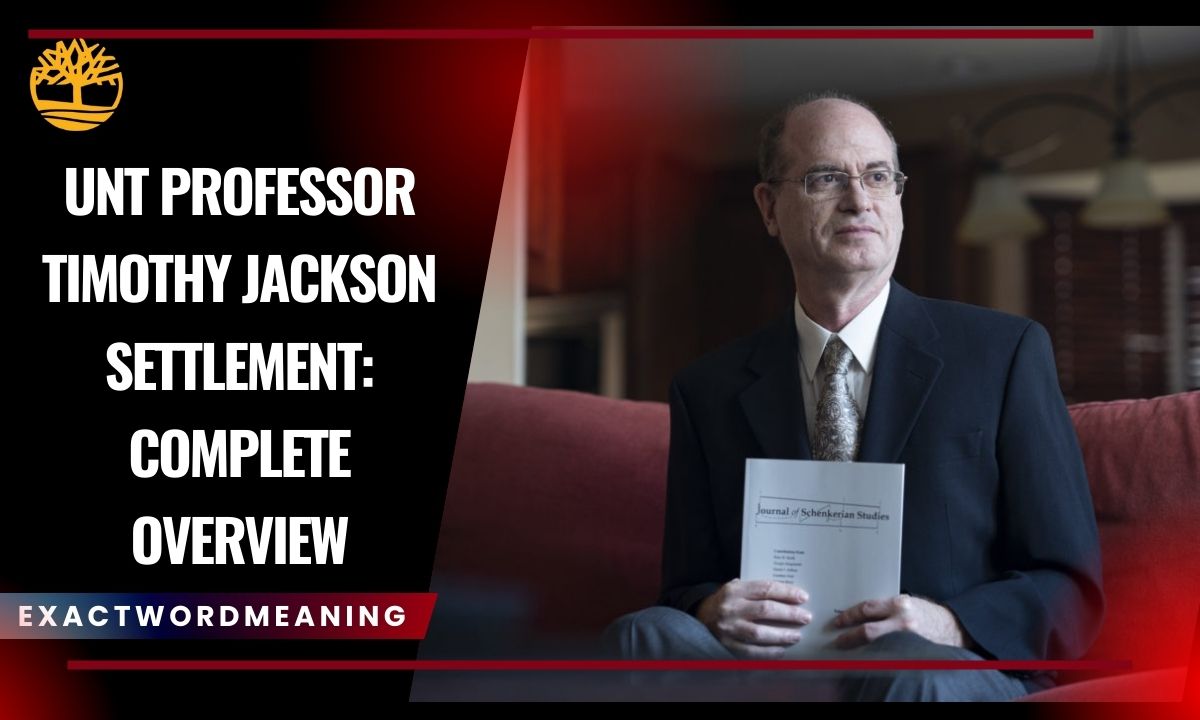
The settlement between UNT and Professor Timothy Jackson has renewed a national conversation about academic freedom. His case shows how quickly debates in higher education can escalate when research and public pressure collide. The agreement closes a long legal battle, but it also highlights how universities handle conflict when scholarship becomes controversial.
Jackson’s return to his editorial role marks a major shift after years of investigation and criticism. The settlement gives him support to continue his work and restores control of the journal he helped build. For many, this outcome signals a broader push to protect open debate, even when the ideas at the center of it are uncomfortable.
Background of the Timothy Jackson Controversy at UNT
The controversy surrounding Timothy Jackson began at a time when discussions about race, scholarship, and academic responsibility were gaining national attention. His work in music theory had already positioned him as a respected figure, but the debate that erupted in 2019 reshaped his role on campus.
The tension rose when Jackson’s published response to a high-profile lecture questioned claims about systemic racism in classical music. His arguments focused on the historical context of Heinrich Schenker, and many saw his writing as provocative. As conversations spread through the university, the criticism moved beyond academic circles and into social media spaces, accelerating the conflict.
The backlash created pressure within the university to respond. Students demanded action, faculty members submitted statements, and the administration began reviewing both Jackson’s article and the journal that published it. These steps set the stage for what would become a prolonged battle over academic freedom and editorial independence.
How the Dispute Began: The Schenker and Ewell Debate
The dispute traces back to Philip Ewell’s 2019 lecture, which argued that Schenker’s writings held racist ideas and that these ideas influenced modern music theory. Ewell’s talk quickly gained attention and sparked discussions across the field. Many scholars supported his claims, describing them as necessary critiques of long-standing traditions.
Jackson disagreed, writing a lengthy response that challenged Ewell’s interpretation. He portrayed Schenker not as a figure of white supremacy but as a Jewish scholar shaped by the antisemitism he faced. Jackson’s article argued that labeling classical music as structurally racist overlooked key historical facts and reduced a complex tradition to political themes.
To support his view, Jackson emphasized points such as:
- Schenker’s experience as an Austrian Jew
- The impact of antisemitism on Schenker’s career
- The importance of contextual analysis in historical scholarship
Jackson’s response was published as part of a multi-author journal issue, but his section drew the strongest reaction. Critics accused him of making insensitive claims about Black musicians, while supporters argued he was defending scholarly nuance. The divide widened, turning an academic disagreement into a high-stakes cultural clash.
Why the Journal of Schenkerian Studies Became the Center of the Conflict
The Journal of Schenkerian Studies became the central battlefield because it was the venue that published the responses to Ewell, including Jackson’s. Jackson was not just an author; he was also the journal’s co-founder and editor. This brought questions about editorial judgment, academic bias, and professional ethics into the spotlight.
Faculty members and students claimed the journal issue was imbalanced, argumentative, and unprofessional. They pointed to certain passages they believed relied on racial stereotypes or dismissed Ewell’s concerns too forcefully. Others argued that the journal was doing its job by presenting multiple viewpoints in a scholarly debate.
The controversy raised questions such as:
- Did the journal fairly represent the full spectrum of views?
- Was Jackson using his role as editor to promote his own perspective?
- Should controversial academic arguments be protected even if they spark backlash?
The journal’s sudden visibility intensified scrutiny. What had previously been a niche academic publication was now central to national conversations about race, music theory, and free speech. UNT’s eventual decision to suspend the journal only amplified the debate and fueled Jackson’s argument that the university had overreached.
University Response: Suspension, Backlash, and Journal Closure
UNT faced immediate internal pressure to act. Students circulated petitions calling for accountability, while faculty members signed letters criticizing both Jackson’s article and the journal’s handling of the debate. The administration convened a special committee to investigate the issue and determine whether editorial misconduct occurred.
The university publicly stated that the journal had failed to follow proper editorial standards. Jackson was removed from his role as editor, and the journal was placed on hold. Officials said the decision was meant to restore academic integrity and address concerns raised by the campus community. Critics, however, saw the actions as an attempt to suppress dissenting viewpoints.
Key steps taken by the university included:
- Removing Jackson from the editor position
- Halting publication of the journal
- Issuing statements condemning alleged editorial errors
- Launching an internal review panel
The response escalated tensions. Supporters of Jackson believed the university bowed to public pressure rather than protecting open debate. Opponents believed the university had acted responsibly to prevent harm caused by what they viewed as racially insensitive scholarship. These conflicting views set the stage for years of litigation.
Inside the Lawsuit: Claims of Free Speech Violations and Defamation
Jackson filed a lawsuit in 2021, arguing that UNT violated his First Amendment rights by punishing him for expressing scholarly opinions. He also included defamation claims against faculty members and a student who publicly labeled his work as racist. The lawsuit framed the controversy as an example of academic censorship driven by political and social pressure.
The case gained national attention because it touched on several major issues in higher education. Jackson argued that his article was part of a legitimate academic debate and that the university’s actions threatened the principle of open inquiry. UNT countered that it had acted within its authority to ensure professional standards.
As the case moved through the courts, several rulings favored Jackson, allowing the lawsuit to continue. Free speech advocacy groups supported him, arguing that universities must protect controversial scholarship. The lengthy process eventually led to a major settlement.
The settlement included:
- $725,000 in monetary damages and legal cost coverage
- Full restoration of Jackson’s editorial role
- Research support and a one-course teaching release
- Dismissal of all First Amendment and defamation claims
The resolution closed the legal chapter but left ongoing conversations about academic freedom, editorial independence, and the boundaries of scholarly debate. For many observers, the case serves as a reminder of how fragile and contested academic discourse can become when it intersects with cultural and political debates.
Court Rulings That Strengthened Jackson’s Case Over Four Years
The legal process stretched across four years, and several court decisions helped shape the direction of the case. Each ruling highlighted concerns about academic freedom, editorial independence, and the limits of university authority. As the case moved forward, judges repeatedly emphasized Jackson’s right to challenge actions taken against him.
Early on, the court rejected the university’s attempt to dismiss the lawsuit. This decision signaled that Jackson’s claims raised significant constitutional questions. It also pushed the case beyond procedural arguments and into a broader discussion about free speech and academic rights. The ruling sent a clear message that the issues needed full examination in court.
Key court rulings included:
- Allowing Jackson’s First Amendment claims to proceed
- Rejecting UNT’s arguments about absolute control over the journal
- Identifying potential violations of academic freedom norms
As additional rulings came down, Jackson’s position strengthened. The Fifth Circuit Court affirmed earlier decisions, opening the door for the case to go to trial. This consistent judicial support increased pressure on the university and ultimately contributed to their willingness to negotiate a settlement.
Details of the $725,000 Settlement Agreement
The settlement marked the end of a long and costly conflict. Under the agreement, Jackson received $725,000, which covered monetary damages and legal expenses accrued during the lawsuit. It reflected the seriousness of the claims and the extensive litigation involved. The amount also highlighted the significance of academic freedom disputes within higher education.

The settlement details included financial terms as well as academic accommodations. Jackson agreed to drop his First Amendment claims and dismiss all defamation allegations against faculty and students. The university, while not admitting wrongdoing, agreed to restore his professional roles and provide new forms of support.
The settlement terms included:
- $725,000 payment to Jackson
- Removal of all legal claims
- Restoration of Jackson’s editorial position
- Research assistance and teaching-release benefits
This agreement allowed both sides to move forward without continuing the legal battle. For Jackson, it offered closure and validation. For the university, it avoided further litigation and public scrutiny.
Restoring the Journal: Jackson’s Return as Editor and Academic Support
A key part of the settlement involved restoring the Journal of Schenkerian Studies. Jackson had co-founded the journal, and its suspension had become one of the most contentious elements of the dispute. The agreement ensured that he would return as editor and resume overseeing publication.
The journal’s restoration also came with new resources designed to support Jackson’s academic work. He was granted a one-course teaching release, giving him additional time for research, writing, and editorial duties. The university would also provide him with research assistance to help rebuild the journal’s operations.
Academic support included:
- Full editorial authority restored
- Research assistants for journal management
- Reduced teaching load for five years
This part of the settlement emphasized the importance of scholarly independence. It also sent a message that academic publications must be protected from institutional interference, even during disagreements or public criticism.
Impact on Academic Freedom and Free Speech in Higher Education
The case became a prominent example of the tension between academic expression and institutional oversight. Universities often struggle to balance free speech with campus climate concerns, especially when scholarship touches on race, identity, or historical interpretation. Jackson’s lawsuit helped clarify how courts may view these conflicts.
The outcome signaled that controversial academic viewpoints deserve protection, even when they spark backlash. It underscored that editorial decisions within scholarly journals cannot be punished simply because a viewpoint is unpopular. The case also raised important questions about whether universities can intervene in academic debates without infringing on constitutional protections.
Wider implications included:
- Clearer expectations for how universities handle sensitive scholarly disputes
- Stronger support for academic editors and controversial research
- Renewed focus on constitutional rights within campus settings
These developments are increasingly relevant as debates about diversity, equity, and free expression continue to shape national conversations.
Why the Settlement Matters for Arts, Humanities, and Open Debate
The arts and humanities rely on open discourse, critical analysis, and the freedom to examine ideas that may challenge dominant narratives. Jackson’s case highlighted just how vulnerable these fields can be when scholarly disagreements become politicized. The settlement reaffirmed the importance of protecting academic independence within humanistic studies.
By restoring the journal and supporting Jackson’s work, the settlement underscored the need for diverse viewpoints within music theory and related fields. It also demonstrated that institutions must respect the autonomy of scholarly publications. Without such protections, academic inquiry risks becoming guided by ideological pressure rather than rigorous debate.
This case matters because it reinforces core principles such as:
- The value of dissenting perspectives
- The necessity of critical examination across disciplines
- The role of journals in supporting unbiased scholarship
The settlement serves as both a reminder and a warning. It shows that when academic freedom is challenged, the consequences can be costly and far-reaching.
Timeline of Events: From the 2019 Debate to the 2025 Settlement
To understand the development of the case, it helps to look at how events unfolded over six years. The conflict began with a scholarly debate but soon expanded into a larger controversy involving petitions, public statements, investigations, and legal action. Each year brought new developments that shaped the final outcome.
Below is a simplified table outlining the major events:
| Year | Key Events |
| 2019 | Philip Ewell presents lecture on Schenker; Jackson responds in journal issue. |
| 2020 | Backlash grows; UNT suspends the journal and removes Jackson as editor. |
| 2021 | Jackson files lawsuit alleging First Amendment and defamation violations. |
| 2022–2023 | Courts reject UNT’s motions to dismiss; Fifth Circuit supports Jackson. |
| 2024 | Settlement negotiations begin late in the year. |
| 2025 | Settlement finalized; Jackson receives $725,000 and returns as editor. |
This timeline shows how a single academic disagreement evolved into a landmark legal case with national implications.
Reactions From Faculty, Advocacy Groups, and the Academic Community
Reaction to the settlement has varied across academic circles. Supporters of Jackson praised the outcome as a major victory for free expression, highlighting the importance of defending unpopular viewpoints. They viewed the settlement as proof that universities must be cautious when responding to academic disagreements.
Some faculty members, however, expressed concern about how the case might affect campus climate. They worried that it could discourage criticism of scholarship, especially when issues of race or identity are involved. Advocacy groups split along ideological lines, with free speech organizations celebrating the ruling and others questioning what it means for diversity and inclusion efforts.
Notable points from reactions include:
- Free speech groups applauded the strengthening of academic freedom
- Critics questioned whether the settlement sends mixed signals to students
- Academic observers noted the case’s importance for future court battles
The settlement continues to spark conversation within higher education, demonstrating that its impact extends far beyond UNT.
Frequently Asked Questions
What led to Timothy Jackson’s lawsuit against UNT?
Jackson sued after being removed as editor and having his journal suspended following backlash to his published article.
What does the $725,000 settlement include?
It covers monetary damages, legal costs, journal restoration, research support, and a reduced teaching load.
Is UNT admitting wrongdoing in the settlement?
No. The university denies any wrongdoing as part of the agreement.
Will Jackson continue editing the Journal of Schenkerian Studies?
Yes. He will resume editing the journal for five years with added university support.
How does this case affect academic freedom debates in the U.S.?
It reinforces protections for controversial scholarship and limits administrative interference in academic publishing.
Conclusion
This case shows how quickly an academic disagreement can grow into a major legal battle. Over four years, the courts examined complex issues involving free speech, scholarly independence, and institutional authority. The final settlement brought clarity and restored Jackson’s position while underscoring the value of open debate in higher education. The outcome will influence conversations about academic freedom for years to come, especially in fields where ideas collide with cultural and political tensions.

Muhammad Shoaib is a seasoned content creator with 10 years of experience specializing in Meaning and Caption blogs. He is the driving force behind ExactWordMeaning.com, where he shares insightful, clear, and engaging explanations of words, phrases, and captions.